
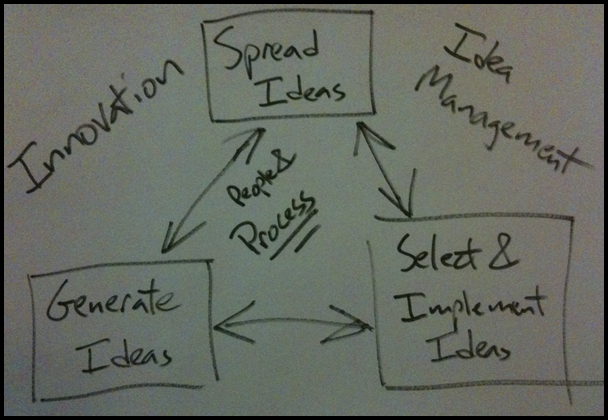
Innovation is the Process of Idea Management
I am always suspicious of one-size-fits-all solutions. They are very easy to sell in a book or a blog post, but they rarely work in the real world. There’s too much variation. That’s a big part of why best practices are stupid.
Just think about the innovation process. I picture it like this:

How many different ways can we do those three steps? I didn’t give this list a huge amount of thought, so I’m sure that I’ve missed a few, but here are forty ways to innovate:
Idea Generation
- get to the edge
- scratch your own itch
- be a genius
- blue sky r&d
- applied r&d
- ask your customers
- watch your customers
- ask your people
- brainstorm
- gamestorm
- think outside the box
- think inside the box
- co-create
- scenario planning
Selection and Implementation
- experiment!!
- r&D
- stage/gate
- innovation team
- innovation coach
- expert panel
- minimum viable product
- iteration
- gut instinct
- does it fit with what we’ve always done?
- do whatever the CEO wants
- focus groups
- market testing
- A/B testing
- team consensus
Spreading Ideas
- network
- traditional distribution
- viral marketing
- advertising
- influentials
- small seeds
- word of mouth
- lead users
- co-creation
- pull strategies
- partnerships
What Combination Should We Choose?
These forty innovation methods can be combined in more than 2300 different ways. So why would should we think that only one way would work?
Within industries we often see one model used. In pharmaceuticals, ideas are generated through applied R&D, they are selected and developed through a stage/gate process, and new innovations are diffused through traditional channels. If everyone is doing it this way, you’d be crazy to stray too far from the pack, right? It would be nuts to come up with new ideas through a co-creation process with your customers, right?
Well, maybe not.
Joseph Schumpeter said:
(Economic) development in our sense is then defined by the carrying out of new combinations.
Carrying out new combinations. If there are at least 2300 ways to combine the different parts of the innovation process, why not innovate how you innovate? That’s what Procter & Gamble did when they developed their open innovation initiative Connect & Develop.
Schumpeter also said that innovation isn’t just about coming up with new stuff. He said it more elegantly than that, but that is the point that he was making. Our processes – the way we do things around here – are things that we often take completely for granted. If you figure out a way to innovate your process, it could lead to a completely new business model. And that’s one of the best forms of innovation around.
It’s time to start thinking about innovating how we innovate.
(combinations between elements) x ( the number of ways to combine) approaches infinite possibility. And I think that permutations count too!
Good post Tim!
Thanks Bart! I agree with you about permutations. And my estimate was the most conservative one possible – I think that your estimate of close to infinity is actually much closer to the truth!