
How big does a new idea have to be to qualify as an innovation?
I read another blog post this morning that tried to tell us that only really big ideas count as innovations. It started something like this:
Innovation is a buzzword now – it’s used so much that it’s lost meaning. Every firm in the world claims to be innovative. But are they really? Does a new flavour of gum really count as innovation? Of course not. Here are five easy steps that will help you do real innovation – big innovation.
The post is, like the many others on this theme, nonsense.
Look – I’ve argued before that we need to be aiming higher, and this is still true. BUT, that doesn’t mean that only big ideas can be innovative.
Austin Kleon has a great way to think about this in his excellent new book Show Your Work. He says:
Amateurs are not afraid to make mistakes or look ridiculous in public. They’re in love, so they don’t hesitate to do work that others think of as silly or just plain stupid. “The stupidest possible creative act is still a creative act,” writes Clay Shirky in his book Cognitive Surplus. “On the spectrum of creative work, the difference between the mediocre and the good is vast. Mediocrity is, however, still on the spectrum; you can move from mediocre to good in increments. The real gap is between doing nothing and doing something.” Amateurs know that contributing something is better than contributing nothing.
I highlighted the key point – the real gap is between doing nothing and doing something.
In other words, we think that the gap is here:

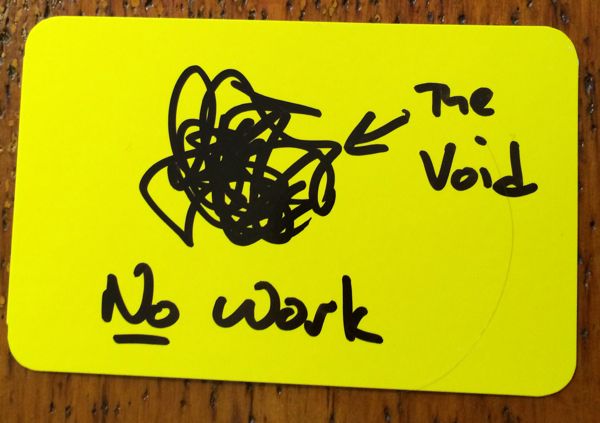
In this view, the opposite of awesome work is terrible work. But it’s not – the opposite of awesome work is no work at all:

That’s why so many people write about how to get work started – because that is actually the big hurdle that we face. Kleon addresses this some in Show Your Work, and it as a big theme in the books from The Domino Project, including Do The Work by Steven Pressfield and Poke the Box by Seth Godin, and in The Flinch by Julien Smith (still available for free on amazon). That’s why Anne Lamont says that the biggest step in writing is getting down a, well, [lousy] first draft.
It’s the same with innovation. The big gap isn’t between people and firms doing incremental innovations and those doing big disruptive ones. The big gap is between those that aren’t innovating at all in any form, and those that are.

Here is why the “only big ideas are innovative” meme is dangerous:
- You need to be on the innovation spectrum. If I’m working with a firm trying to improve their innovation outcomes, it is much easier to have an impact with the firms that are at least doing something. They’re on the innovation spectrum. The firms that are tough are the ones that aren’t doing any innovating at all. The biggest gap is between doing nothing and doing something.
- You can’t tell which ideas are big in advance. Big innovations usually start small. If we start screening for size too early, we’ll knock out too many ideas that could actually be big. That’s why we need to build our skills in experimenting – this is how we figure out which small bets are promising.
- It’s too easy to be critical if you’re in the “doing nothing” group. The biggest issue is that the critics are almost always in the “doing nothing” group. The people that have already done it know how hard it is, so on average they tend to be more generous with people that are putting in the work. The people that tend to be the hardest on incremental innovators are the people that have never done anything innovative themselves.
Here’s the deal:
Writers write.
Painters paint.
Photographers shoot.
And innovators innovate – even if it’s just small stuff.
Remember that from little things, big things grow. Start trying new stuff now.

[…] Should "innovation" only be used to refer to big, world-changing ideas? No. This is actually a dangerous approach to innovating. The biggest hurdle is actually getting started – it's more important… […]
[…] ( Tim Kastelle) How big does a new idea have to be to qualify as an innovation?I read another blog post this morning that tried to tell us that only really big ideas count as innovations. It started something like this:Innovation is a buzzword now – it’s used so much that it’s lost meaning. Every firm in the world claims to be innovative. But are they really? Does a new flavour of gum really count as innovation? Of course not. Here are five easy steps that will help you do real innovation – big innovation. […]
Timely and to the point…excellent Tim
Thanks Shaun – I’m glad you liked it! I hope that you’re doing well. We should catch up soon.
[…] Of course, once we have our ideas, we have to execute them – an issue that Justine Musk addresses in Darling, Just Freaking Do It. As I pointed out yesterday, the big creative gap is not between those doing lousy work and those doing great work. The bigger gap is between those doing nothing and those doing something. […]
[…] ( Tim Kastelle) How big does a new idea have to be to qualify as an innovation?I read another blog post this morning that tried to tell us that only really big ideas count as innovations. It started something like this:Innovation is a buzzword now – it’s used so much that it’s lost meaning. Every firm in the world claims to be innovative. But are they really? Does a new flavour of gum really count as innovation? Of course not. Here are five easy steps that will help you do real innovation – big innovation. […]
Thank you Tim,
Some terrible works leave the debris and concrete block. It is required additional effort to either rebuild or get another idea to be developed.
Think about innovation process, so the claim of researcher is applied in the process. See whether the claim get the same result in prototype scale. Beside the incremental innovation (far from awesome), “Terrible” in your writing means go back to research project to validate the result or go to modification project.
[…] blogging helps you build your skills. Remember, the big gap is the one between doing nothing and doing something, not the one between lousy work and great work. Why am I willing to consistently put some of the […]
[…] Should "innovation" only be used to refer to big, world-changing ideas? No. This is actually a dangerous approach to innovating. The biggest hurdle is actually getting started – it's more important… […]
[…] Button in the Sky. Then more time will pass and I’ll turn 70 and no one will really care. I read a post today that said the big fear gap we need to cross is not between doing bad work and doing great […]
[…] Writers write and innovators innovate: “The big gap isn’t between people and firms doing incremental innovations and those doing big disruptive ones. The big gap is between those that aren’t innovating at all in any form, and those that are.” One of the things that encourages me to keep inching forward is the thought that it takes so little action to distinguish yourself from people who never take that first step. It’s depressing (how can so many people be stuck?), but it’s also encouraging (how can I help them get unstuck, and in the meantime, how can I make the most of these small steps?. […]
[…] Of course, the big gap is not between people doing lousy work and those doing great work – the biggest gap is between those doing nothing and those doing something. To help you make that jump, James Altucher has written The Ultimate Cheat Sheet for Dealing With […]
I spent a few years at the UN and wish this attitude was more widespread, not as a critic because I know how hard it is to work in the organisation and to get things done with so many agenda’s and egos, etc., but more as someone who would have loved to experimented more.
[…] Of course, the big gap is not between people doing lousy work and those doing great work – the biggest gap is between those doing nothing and those doing something. To help you make that jump, James […]